Instant Auctions
Unlocking Faster Freight Matching Through Instant Bid Responses
Company
Convoy
Industry:
Freight

About Convoy
The Convoy Carrier App connects drivers and fleets to a digital freight marketplace, allowing them to find, bid, and manage loads in real time. My design work focused on improving booking flows, visibility, and feedback loops to reduce driver downtime and increase trust in automated bidding systems.
Project Goal
Reduce the amount of time carriers have to wait by providing an immediate response after they place a bid.
Opportunity
Evaluating how faster feedback impacts carrier trust and participation.
Instant feedback → More bids → More matches → Stronger marketplace.
Results
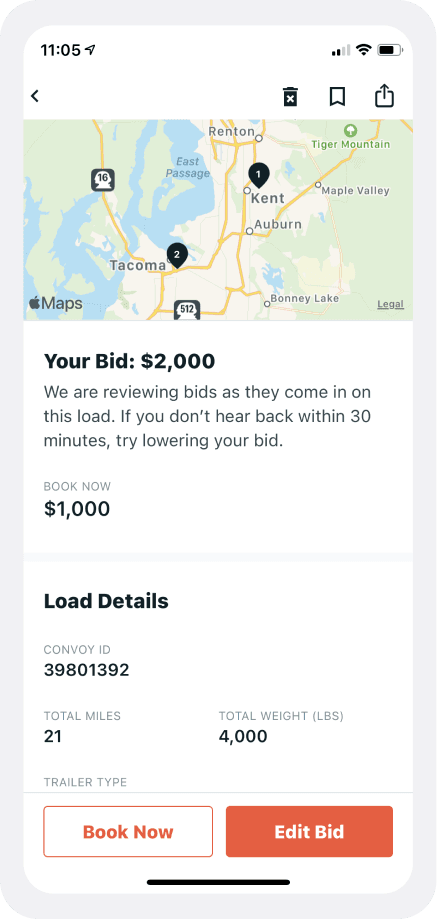
Instant Auctions was highly successful.
"This is the best of the best. In the past, I couldn’t always accept Convoy loads that I had won, because I’d booked another load while waiting for a response. Now, I know right away if I’m going to haul it, so I don’t need to search for another load. This significantly reduces the time it takes me to plan and book my schedule!”
Ghareeb Nawaz, Stryker Trans
Josh Rickards, Rickards Transportation Services LLC
Research
Evaluating how faster feedback impacts carrier trust and participation.
Instant feedback → More bids → More matches → Stronger marketplace.
Key Findings
Solutions
Tradeoff: Negotiation Experience vs. Model Integrity
🎨 Design Perspective
Carriers wanted a natural back-and-forth negotiation, like traditional brokerage — more human, flexible, and fair.
🧠 Data Science Perspective
Multiple counters would destabilize pricing models, creating feedback loops and reducing accuracy.
✅ Decision
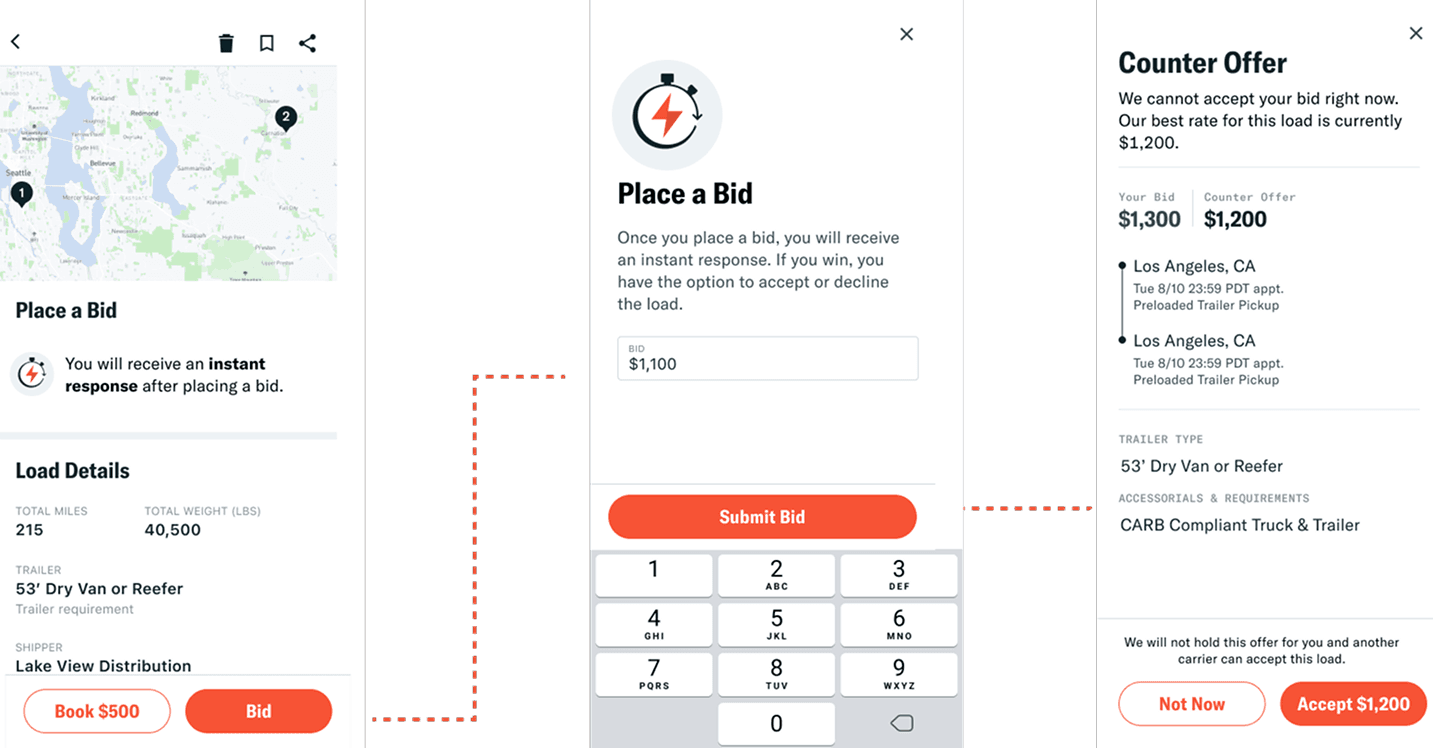
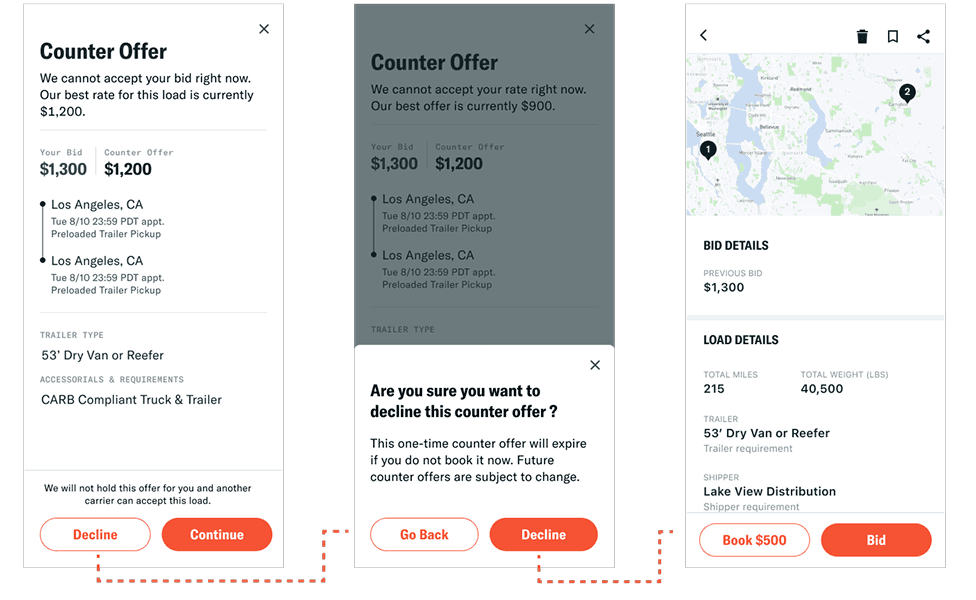
Limit to one counteroffer cycle to preserve model reliability. Carriers can rebid manually, but each is treated as a new negotiation.
Acceptance Window
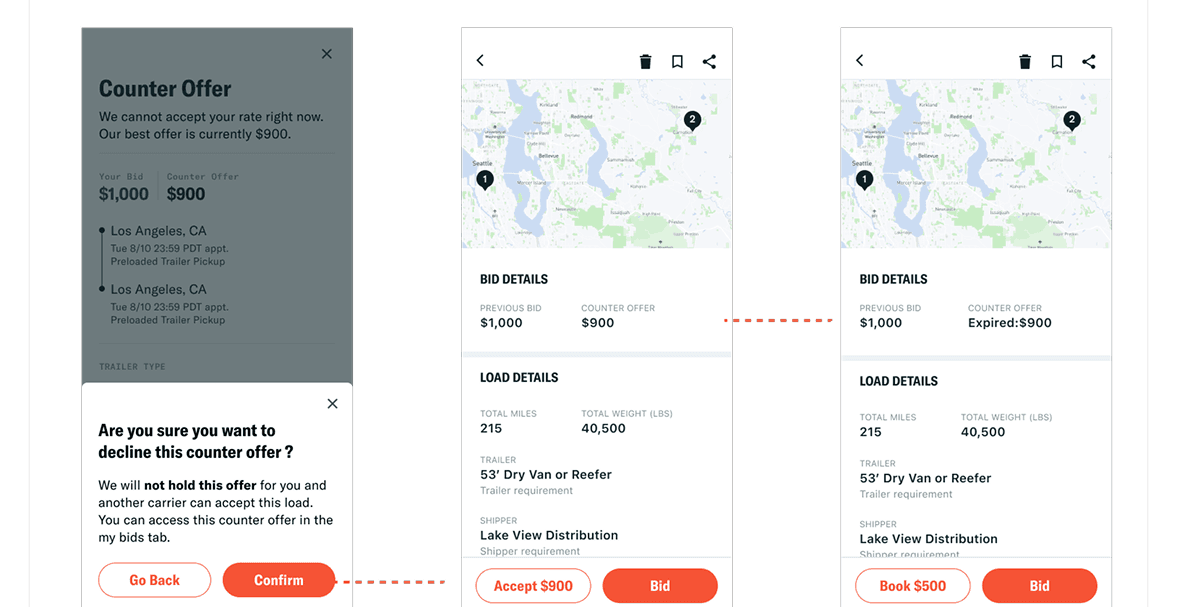
We allowed a 15-minute acceptance window for logistics. We did not provide a timer, but instead adjusted the booked now rate to the counteroffer price and showed expired under counteroffer info item.
Tradeoff:
User Sentiment vs. Market Efficiency
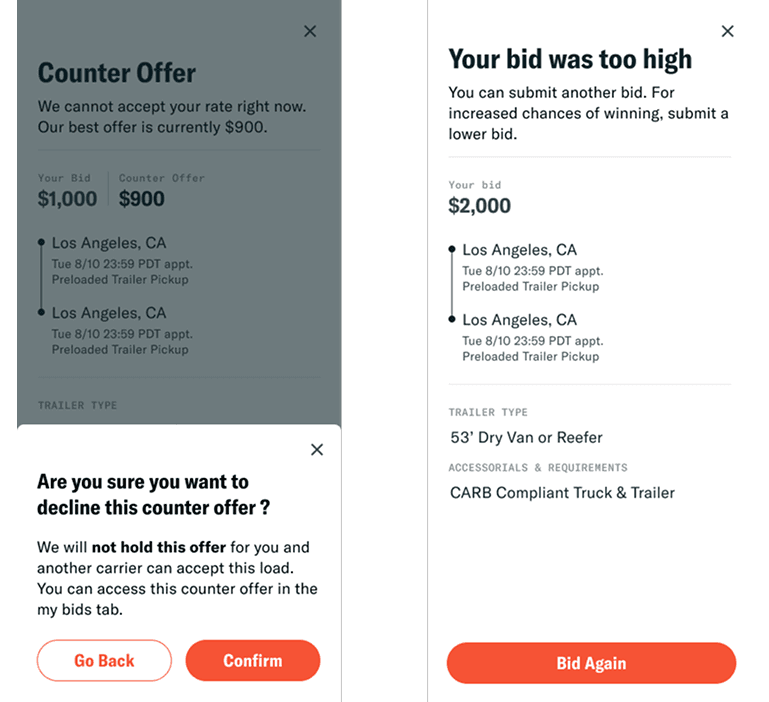
When a carrier’s bid was rejected, the team debated whether to “soften” the rejection message — for example, by adding friendlier language (“Your bid wasn’t accepted this time, but we’d love to see you bid again soon!”) or subtle hints (“Try bidding slightly higher next time”).
The question was: should the system empathize or optimize?
🎨 Design tradeoff: Empathy vs. Clarity
💡 Decision: Chose a firm rejection to encourage realistic bids and reduce confusion.
📊 Impact: Faster market resolution, cleaner data, fewer double acceptances.
Rollout Phase 1- 30%
Measuring Impact & Investigating Friction
📊 Monitored feedback loops: CS calls, in-app feedback, brokerage data.
💬 10 carrier interviews: Explored pain points around rates and trust.
🔍 Outcome: Identified pricing perception as key barrier → informed next iteration vs. rollback decision.
User Research - Key Findings
✅ Carriers prefer Instant Auctions — faster responses and less waiting improved overall satisfaction and planning efficiency.
⚠️ Low counteroffers discouraged re-bids — carriers perceived early offers as unfair or uncompetitive, reducing engagement.
⏳ Urgency gap in counteroffers — without time pressure, even acceptable offers failed to drive immediate action.
💰 Counteroffers often below market — pricing too close to “accept now” rates led to distrust and fewer matches.
📉 Conservative initial pricing — encouraged “last-minute” bidding behavior and slowed early marketplace activity.
⚠️ Lack of bid status transparency — carriers grew frustrated by unclear communication about held bids and wanted control to cancel.
Rollout Phase 2
Design Goal: Simplify the Flow & Re-Engage Carriers
🧩 Removed acceptance timer → Simplified decision flow; fewer expirations.
💬 Revised decline modal → Set clearer expectations, encouraged re-bidding.
📈 Outcome: Increased rebid rate, improved carrier retention metrics.
Validating the Rollout: Quantitative Phone Survey
🤝 Partnered with Data Science → Designed structured survey to test rollout readiness.
☎️ 100 carrier calls via CS team → Quantified preference for Instant vs. Timed Auctions.
📊 Goal: Validate experience quality before 100% launch.
Learnings & Reflections
Designing for both user trust and algorithmic stability required tradeoffs.
Carriers valued clarity and fairness more than unlimited negotiation — proving that simplicity can still feel empowering when expectations are clear.
Thanks for reading 😊